Safety first before you start checking
Before touching anything, make sure it is safe to do so. You should never remove your boiler’s outer case, adjust anything on the gas pipework or attempt to fix internal components yourself. Those jobs are strictly for Gas Safe registered engineers.
You can safely check your controls, boiler display, visible pipework and radiators. If you ever smell gas, see scorch marks, or the boiler is making loud banging noises, turn it off at the controls and contact a Gas Safe engineer immediately.
Step 1: Check hot water is actually “on”
It sounds basic, but it is the first thing an engineer will ask. Start by checking your programmer or timer, then the boiler controls themselves.
Programmer/timer: Make sure the hot water channel is set to “On” or “Continuous” and not just “Heating”.
Room thermostat: This usually only controls heating, but if it is turned right down, confirm that the heating still fires as normal.
Hot water temperature control: On combi boilers, check the hot water temperature dial has not been accidentally turned very low.
If everything appears correctly set but your taps still run cold or lukewarm, move on to the next checks.
Step 2: Work out if you have a combi or system boiler
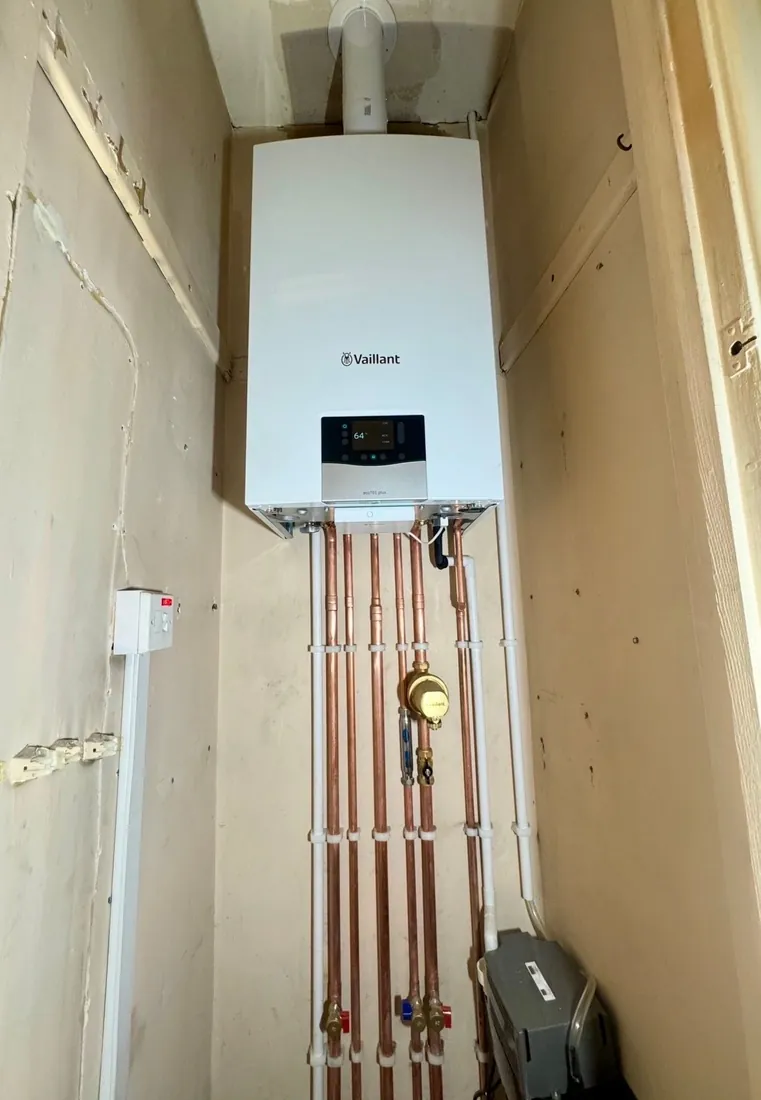
The fault-finding steps are slightly different depending on your setup. A combi boiler heats water directly from the mains, so there is no separate hot water cylinder. A system or regular boiler uses a cylinder, usually in an airing cupboard, to store hot water.
If you see a large hot water tank with a thermostat attached, follow the system boiler checks below. If you just have the boiler and no cylinder, follow the combi boiler checks.
Step 3: Checks for system boilers with a hot water cylinder
Programmer, cylinder thermostat and motorised valves
With a cylinder system, several components have to work together to give you hot water. If one fails, you may still have heating but lose hot water.
2. Cylinder thermostat Find the thermostat on the side of the hot water cylinder. Check it is set around 60 °C, then gently turn it up and down. You should hear a small click as it passes the current temperature. If it is set very low or does not seem to respond, this may be the issue.
3. Motorised valve position Near the cylinder there is usually a small metal box on the pipework (a 2-port or 3-port valve). When hot water is called for, the lever on this valve should move. If heating works but hot water never comes on, the valve may be stuck or faulty. This is not a DIY repair but is useful information for the engineer.
Step 4: Checks for combi boilers with no cylinder
Diverter valve symptoms and simple tests
On a combi, it is common to have radiators working but no hot water because the diverter valve has stuck in the heating position. This internal valve sends hot water either to your taps or to your radiators.
If the boiler does not react to the tap, or the radiators start warming up when you run the tap, the diverter valve is likely faulty and needs a Gas Safe engineer to replace or repair it.
Step 5: Check boiler pressure, error codes and condensate pipe
System pressure and error messages
Look at the pressure gauge on your boiler (usually a round dial or digital display). When the system is cold, it should normally sit around 1.0 to 1.5 bar. If it has dropped very low, your boiler may limit its operation.
Most homeowners are allowed to top up the pressure using the filling loop if your manual confirms this, but never keep repressurising a system that keeps dropping; that points to a leak that needs professional attention.
Next, check the boiler display for any fault codes or flashing lights. Jot these down, as they are extremely helpful for an engineer and often indicate sensor issues, flow problems or ignition faults.
Frozen condensate pipe in cold weather
In freezing conditions, a common cause of no hot water is a frozen condensate pipe. This is a plastic waste pipe that usually runs from the boiler to an outside drain. If it freezes, the boiler will typically lock out and show an error code.
If you suspect this, you can safely pour warm (not boiling) water over the external section of the plastic pipe to gently thaw it, then reset the boiler following the manual. If the pipe keeps freezing, you will need an engineer to improve the insulation or reroute it.
Common causes, symptoms and what to do
Use this quick reference table to narrow down likely causes. Do not attempt internal repairs yourself.
Symptoms → Likely cause → What to do
Heating works, hot water stone cold, no boiler reaction to taps Faulty diverter valve or flow sensor on combi → Call a Gas Safe engineer for diagnosis and replacement.
Heating works, cylinder lukewarm only, hot water times set correctly Faulty cylinder thermostat or motorised valve → Ask an engineer to test and replace the faulty part.
Both heating and hot water fail in cold weather, gurgling or external pipe dripping slowly Frozen condensate pipe → Safely thaw with warm water and reset; call an engineer if it recurs.
The boiler works intermittently, and the pressure is often low System losing pressure → Check visible pipework and radiators for leaks, then call an engineer.
Good water flow from taps, but only lukewarm Temperature set too low, scaled plate heat exchanger, or faulty sensor → Check temperature controls; if still poor, book a service.
When to stop fault-finding and call a professional
If you reach any point where you feel unsure, stop and call a professional. You should not remove boiler covers, tamper with gas valves, bypass safety devices or attempt complex electrical testing.
In older, hard-water areas such as Bristol, Bath, the Mendips and Weston-super-Mare, internal components can also become scaled up more quickly, reducing hot water performance and requiring specialist cleaning or replacement.
Regular servicing keeps these parts clean, checks safety devices and often prevents the “heating works but no hot water” problem from happening in the first place.
Book expert boiler servicing or repair
If you have run through these checks and still have heating but no hot water, it is time to bring in a Gas Safe registered engineer. Proper testing equipment and experience are needed to safely diagnose diverter valves, sensors, heat exchangers and controls.
SNT Plumbing and Heating provides boiler servicing and repairs across Bristol, Bath, the Mendips and Weston-super-Mare, helping homeowners get reliable hot water back as quickly as possible. To arrange a visit or discuss symptoms, call 07775504887 or book online via our boiler servicing & repairs page.